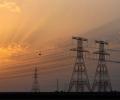
NDA's energy plan powered UP win, but it's not a winner yet. Centre has claimed to have saved money by targeted coverage but critics say the system is not yet foolproof.
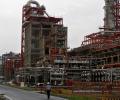
Rosneft bought a 49 per cent stake in Essar Oil's refinery port and petrol pumps, while Netherlands-based Trafigura Group Pte, one of the world's biggest commodity trading companies, and Russian investment fund United Capital Partners split another 49 per cent equity equally.

The fiscal deficit of the Centre remains a worry, running at over 6.5 per cent of GDP in April-September 2014, mainly because of revenue shortfalls from exaggerated projections in the government's July Budget and despite the relief on subsidies from lower oil prices.

With the stock market entering a bull phase, many believe the Singals can bring in the much-needed equity capital and reduce their debt.

In 2012, with one million deaths, China reported the highest toll from PM2.5 and PM10 pollution. At the time, India followed, reporting 621,138 deaths, nearly 10 per cent of the global toll associated with outdoor and indoor air pollution

Delhi Metro, Yamuna-expressway and Tata Power's Mundra ultra mega power project in Gujarat are among the six ventures that have figured in the list of world's most innovative, impactful infrastructure projects prepared by international accounting firm KPMG.
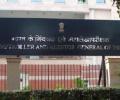
Instead of only government departments and state-owned undertakings, the CAG can now audit private companies, too.

'Poor home work, and a subsequent loss of nerve.' 'This sums up the Modi government's current travails, the stall in key sectors, fading momentum, irritability,' points out Shekhar Gupta.

Aseem Chhabra picks 10 fascinating films he watched in Macao -- a blend of Asian, independent, Hollywood projects and even a 66-years-old classic Japanese film that still stands the test of time.
Expenditure cuts necessitated by slowing revenue growth, weak industrial activity worrisome portents

Penpix of the India squad for the 2015 cricket World Cup, which is being held in Australia and New Zealand.
'Good politics is not just staying in power. You cannot sacrifice everything at the altar of trying to ensure the coalition remains in power.'
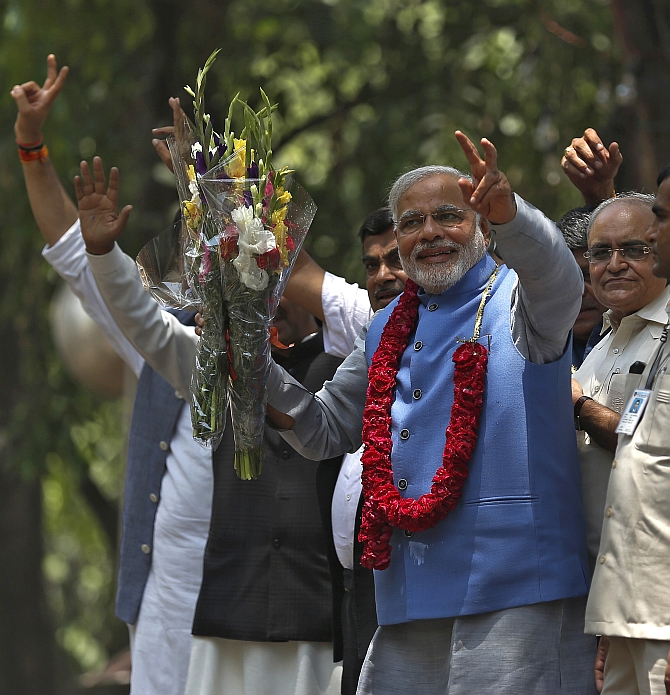
Modi govt says its economic score on all coutns is very good.

For existing technologies, unless appropriate financing is available, deployment at scale is difficult.

IT shares lost ground tracking a sell-off in tech stocks on Nasdaq on Friday

This is the lowest investment grade rating.

The Sheikh Hasina-Narendra Modi summit put India-Bangladesh ties on a firmer pitch. Brigadier S K Chatterji (retd) takes stock.

'On the tax front, most of the Budget proposals are sensible'.

Out of these, no balance has been found in case of 289 accounts

The industry's reactions to the Budget have been mixed.

The power to cause societal pain, at least to some segments of society, is intrinsic to the nature of technological innovation.
.jpg)
The catalyst is the run on emerging market equities, but many investors are just tired of waiting for India to get its act together.

'High denomination cash notes which was 1.4 lakh crores of Rs 500 and Rs 1,000 notes in 2004 became Rs 15.5 lakh crores in 2016.' 'If it had been allowed, by 2022, it would have been Rs 34 lakh crores, and that would have been the end of the Indian economy.' 'Demonetisation was a huge hit on the head of the economy, but without the hit, you could not U-turn the economy.'

'No matter how severe sanctions the UN security council imposes on North Korea, the impact of the sanctions would depend on how faithfully they are enforced by China,' says Dr Rajaram Panda.

Prime Minister Narendra Modi, who recently completed one year in office, has, in an exclusive interview with Smita Prakash, editor, ANI, said the opposition alleging that his government is a "suit boot ki sarkar" is definitely better and more acceptable than being labelled a "suitcase" (ki sarkar), and satirically added, that after ruling for sixty years, the Congress has suddenly remembered the poor.

What are the most worrisome aspects of climate change for India? Can they be solved?
.jpg)
We present Prime Minister Manmohan Singh's full speech as he addressed the country on the occasion of 66th Independence Day, from Red Fort, Delhi.

2015 is going to witness new agreements on climate change.

For 70 years the country has been looted, give me 70 months I will clean it up, he said.

The 30-share Sensex surged 299 points to close at 28,736 and the 50-share Nifty gained 90 points to end at 8,723.

All the Gujarat cadre officers have one thing in common. They do not need Modi's 'informal interactions' and advice because they are from the so-called 'Modi school of governance.' They know Modi well enough to perform their assigned roles.
However, the budget arithmetic is slightly optimistic.

In the heat and dust of a Baramati rally with Supriya Sule.

Then chief minister Jyoti Basu once told an industrialist that capitalists were class enemies and he should expect no sympathy.

The current crisis Karnataka Chief Minister Siddaramaiah is facing is a cumulative effect of inattention to water management and the fiscal burden of populist promises, says Aditi Phadnis.

There are conflicting signs on India's investment cycle.
Employers' refusal to recognise TUs has caused industrial tiffs.

Indian states are preparing for a Rs 1.9 lakh crore (Rs 1.9 trillion) tax windfall this fiscal year.

This is the full text of Prime Minister Manmohan Singh's address to media persons ahead of his interaction with them in New Delhi on Friday
.jpg)
The 30-share Sensex ended 117 points higher at 26,560 and the 50-share Nifty gained 31 points to end at 7,936.
